Saturday, February 2, 2013

Convicted murderer mistakenly freed recaptured in Illinois


Convicted murderer mistakenly freed recaptured in Illinois
FOX NEWS | FEBRUARY 2, 2013
http://pulse.me/s/i5ruc


A convicted murderer from Indiana who was mistakenly released after a Chicago court appearance was back in custody Saturday after authorities tracked ... Read more

--
Sent via Pulse/

Alabama standoff continues as officials silent about talks with alleged abductor


Alabama standoff continues as officials silent about talks with alleged abductor
FOX NEWS | FEBRUARY 2, 2013
http://pulse.me/s/i5n4P


As a police standoff with an Alabama man accused of holding a 5-year-old boy hostage in an underground bunker entered its fifth day, authorities were ... Read more

--
Sent via Pulse/

North Korea threatens US over response to rocket launches


North Korea threatens US over response to rocket launches
FOX NEWS | FEBRUARY 2, 2013
http://pulse.me/s/i60fL


North Korea is threatening to retaliate for what it calls U.S. double standards over recent rocket launches by Pyongyang and U.S. ally Seoul. A North... Read more

--
Sent via Pulse/

Vile plans to cheat the Electoral College

Vile plans to cheat the Electoral College
http://www.nypost.com/p/news/opinion/opedcolumnists/vile_plans_to_cheat_the_electoral_SdkWGvLfCQbc3A1mQLefTK?utm_medium=rss&utm_content=Oped%20Columnists


Democrats are up in arms about an effort to change the formula by which several so-called purple states allocate their votes in the Electoral College. The scheme would select the electors by congressional district, thereby increasing the odds, based on recent elections, for the Republicans to win the presidency. No wonder Democrats, and many others, are upset.

Funny, though, that there's been hardly a peep from the Democrats about an even more radical scheme to change the way the president is elected — the National Popular Vote Interstate Compact. This would require a state's delegates to the Electoral College to vote for whoever wins the national popular vote. Never mind who won in the state the electors come from.

This idea really got going after 2000, when George W. Bush won the presidency even though he lost the national popular vote to Albert Gore. It's now been ratified, and passed into law, by eight states, who have a total of 132 electoral votes.

Once the compact has been ratified by states with a total of 270 electors (that is, enough to command a majority in the Electoral College, and elect a president), every state that's ratified it will be required by its own law to order its electors to vote for the winner of the national popular vote.

New York, notably, is halfway there, since the state Senate has ratified the measure.

If the scheme had been in effect in 2004, delegates to the Electoral College from New York would have had to cast the state's votes for George W. Bush even though John Kerry won the state by a margin of 1.4 million votes.

Call it the purpling of New York.

At the moment, the only institution standing between this scheme and New York state is Assembly Speaker Sheldon Silver — who doesn't seem to be in any rush to embrace the idea.

It may be that Silver's been persuaded by the pragmatic argument that the whole thing could blow up in his face: What if the scheme handed the White House to a Republican? It's not hard to imagine some Democratic states trying to back out, with the whole thing winding up in the courts in an even uglier mess than 2000.

Still, Silver hasn't put out any principled statement in opposition. And the idea seems to be favored by those that hew to the Democratic Party. Every state that's ratified it — Maryland, Massachusetts, Washington, Vermont, Hawaii, New Jersey, Illinois and California, plus the District of Columbia — votes Democratic. The newspapers endorsing it lean the same way.

One attraction is that it's much easier than amending the Constitution to actually eliminate the Electoral College; that would require three quarters of the states to approve. The Constitution says in Article II only that electors shall be appointed by each state "in such Manner as the Legislature thereof may direct." So the states, including New York, have a free hand.

The question is whether they should play that hand the way their local voters say, or the way the voters in the rest of the country say.

The New York Times endorsed the idea as recently as November. Its editorial complained of "the tarnish of the Electoral College" — even though the candidate the paper endorsed, Barack Obama, had just again won the presidency.

The compact's most eloquent advocate here is The New Yorker's Hendrik Hertzberg, a former speechwriter for President Jimmy Carter. He has argued that one of the advantages of the National Popular Vote Interstate Compact is precisely that it doesn't require a constitutional amendment. So if participating states turn out to be unhappy with the results, they can change the system back.

Well, you could sell the Brooklyn Bridge back, too.

The fact is, the drive for this popular-vote compact is part of a decades-long push by the Left against the idea that the states themselves have their own standing in the federal system. The Left even resents the existence of the Senate, where small states have the same representation as large ones.

In short, the Founders wanted a system that was both national but also accommodated the immortal principle that politics is local.

Lipsky@nysun.com

Have a comment on this PostOpinion column? Send it in to LETTERS@NYPOST.COM!


(via Instapaper)

Biden says US prepared to hold direct talks with Iran

Biden says US prepared to hold direct talks with Iran
http://www.foxnews.com/politics/2013/02/02/biden-underlines-willingness-for-direct-iran-talks/?utm_source=feedburner&utm_medium=feed&utm_campaign=Feed%3A+foxnews%2Fpolitics+%28Internal+-+Politics+-+Text%29


MUNICH – The United States is prepared to hold direct talks with Iran in the standoff over its nuclear ambitions, Vice President Joe Biden said Saturday — but he insisted that Tehran must show it is serious and Washington won't engage in such talks "just for the exercise." Washington has indicated in the past that it's prepared to talk directly with Iran, and talks involving all five permanent members of the U.N. Security Council plus Germany have made little headway. Several rounds of internationoal sanctions have cut into Iran's oil sales and financial transactions. Last month Iran, in a defiant move ahead of a new round of talks expected soon with the six powers, announced plans to vastly increase its pace of uranium enrichment. That can be used to make both reactor fuel and the fissile core of warheads. Biden told an international security conference that "there is still time, there is still space for diplomacy backed by pressure to succeed." He did not specify any timeframe. He insisted that "the ball is in the government of Iran's court" to show that it's negotiating in good faith. Asked when Washington might hold direct talks with Tehran, Biden replied: "when the Iranian leadership, the supreme leader (Ayatollah Ali Khamenei), is serious." The U.S. has long made clear that it is prepared to meet directly with the Iranian leadership, he added — "that offer stands but it must be real and tangible and there has to be an agenda that they're prepared to speak to." "We're not prepared to do it just for the exercise," Biden told the Munich Security Conference. Iran insists it does not want nuclear arms and argues it has a right to enrich uranium for a civilian nuclear power program, but suspicion persists that the real aim is nuclear weapons. The Islamic Republic hid much of its nuclear program until it was revealed from the outside more than a decade ago. And defying U.N. Security Council demands that it halt uranium enrichment, Iran has instead expanded it. "Iran should not wait any longer to take up the willingness Vice President Biden has stressed to hold substantial negotiations on its nuclear program," said Foreign Minister Guido Westerwelle of Germany, whose country has been one of those trying to resolve the issue. He added that 2013 would be "decisive" for hopes of a diplomatic solution. "From our point of view, announcing an accelerated expansion of uranium enrichment in Iran is the wrong signal," Westerwelle said. Biden underlined that "our policy is not containment — it is to prevent Iran acquiring a nuclear weapon." The conference — an annual gathering of top security officials — also gave Biden an opportunity to address the civil war in Syria. He planned to hold separate meetings with Russian Foreign Minister Sergey Lavrov, international peace envoy Lakhdar Brahimi, and Syria's top opposition leader, Moaz al-Khatib. Russia is a longtime ally of Syrian President Bashar Assad. Biden stressed the conviction of the U.S. and many others that "President Assad — a tyrant hellbent on clinging to power — is no longer fit to lead the Syrian people and he must go." He said that "the opposition continues to grow stronger." Despite differences, "we can all agree on the increasingly deep plight of the Syrian people and the responsibility of the international community to address that plight," he told an audience that included Lavrov. But Lavrov fired back that "there are a lot of question marks about the Western approaches to those developments," in the region, asking whether supporting antigovernment protesters justified terrorists, and questioning when it is "permissible to cooperate with regimes and when is it legitimate to argue for their removal." "We are all interested in the stability of the Mideast and the African continent," and for governments to be democratic and peaceful, Lavrov said. "If we agree on these common objectives we could probably agree on some transparent and common rules for all actors to follow." Biden also sketched out the Obama administration's foreign policy priorities for its second term, taking care to reassure Europeans that its "pivot" to Asia and the Pacific following a decadelong entanglement in Iraq and Afghanistan won't come at the expense of transitional trans-Atlantic ties. "This engagement does not come at Europe's expense," he said. "It's profoundly in Europe's interest for America to engage more broadly with the world."

(via Instapaper)

Friday, February 1, 2013

Tweet from AJC (@ajc)

AJC (@ajc)
Former NYC Mayor Ed Koch died today. He was 88. bit.ly/W6D6EE

Download the official Twitter app here

Sun wins the Beckham punning prize

Sun wins the Beckham punning prize

by Roy Greenslade, guardian.co.uk
February 1st 2013

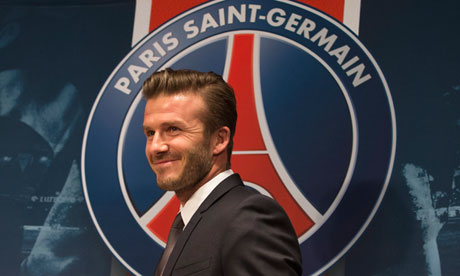
David Beckham's decision to join Paris Saint-Germain got major billing in Friday's national newspapers, offering sub-editors the chance to compose a range of punning headlines.

Most were on the front page. Some led off the sports sections. A few were straightforward, such as "Saint David" in the Daily Telegraph and "Saint Becks" in the Daily Mirror. Similarly, the Daily Express went with "Now Saint Becks heads to France … and gives £3m salary to charity."

The Daily Mail also highlighted the charity angle with "Golden Gift: I'll give my £3.4m PSG wages to charity, says Beckham."

The Daily Star chose "Bonjour Beckham" but the Times wittily stretched its readers' knowledge of French just a little further with "Alors, sur ma tĂȘte, mon fils."

Its inside page was "Beckham delighted with Paris match", and the Guardian's front featured that pun too: "Paris match: Beckham signs for France's richest club – and gives wages to charity."

The Independent, under a picture of Beckham walking smartly along a street, presumably in the French capital, preferred "Our new man in Paris scores an early goal."

Oddly, its little (actually big) sister, i, carried only a blurb: "Paris says bonjour to Le Spice Boy." And Metro preferred "One free man and a French revolution."

The Financial Times shunned puns with "Beckham joins Paris Saint-Germain". But it was carried only on its website (where puns don't go down well with SEO requirements).

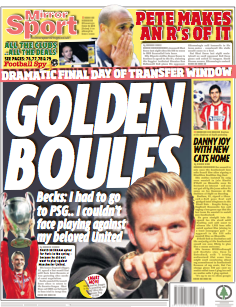
Top pun by far was, unsurprisingly, in The Sun: "Golden Boules". And, thanks to commenters, I now see the Mirror carried the same head on its back page (sorry for the oversight - memo to self: turn to the back when dealing with sport).

Arguably the most delightful spoken pun came from Garry Richardson on Radio 4's Today programme, who asked at the end of his sports spot: "Do you think he went through the French window?"

Original Page: http://pocket.co/swIiR

Shared from Pocket